
Oak Observations July 2025
Partner Spotlight – WA DNR White Salmon Oak Restoration
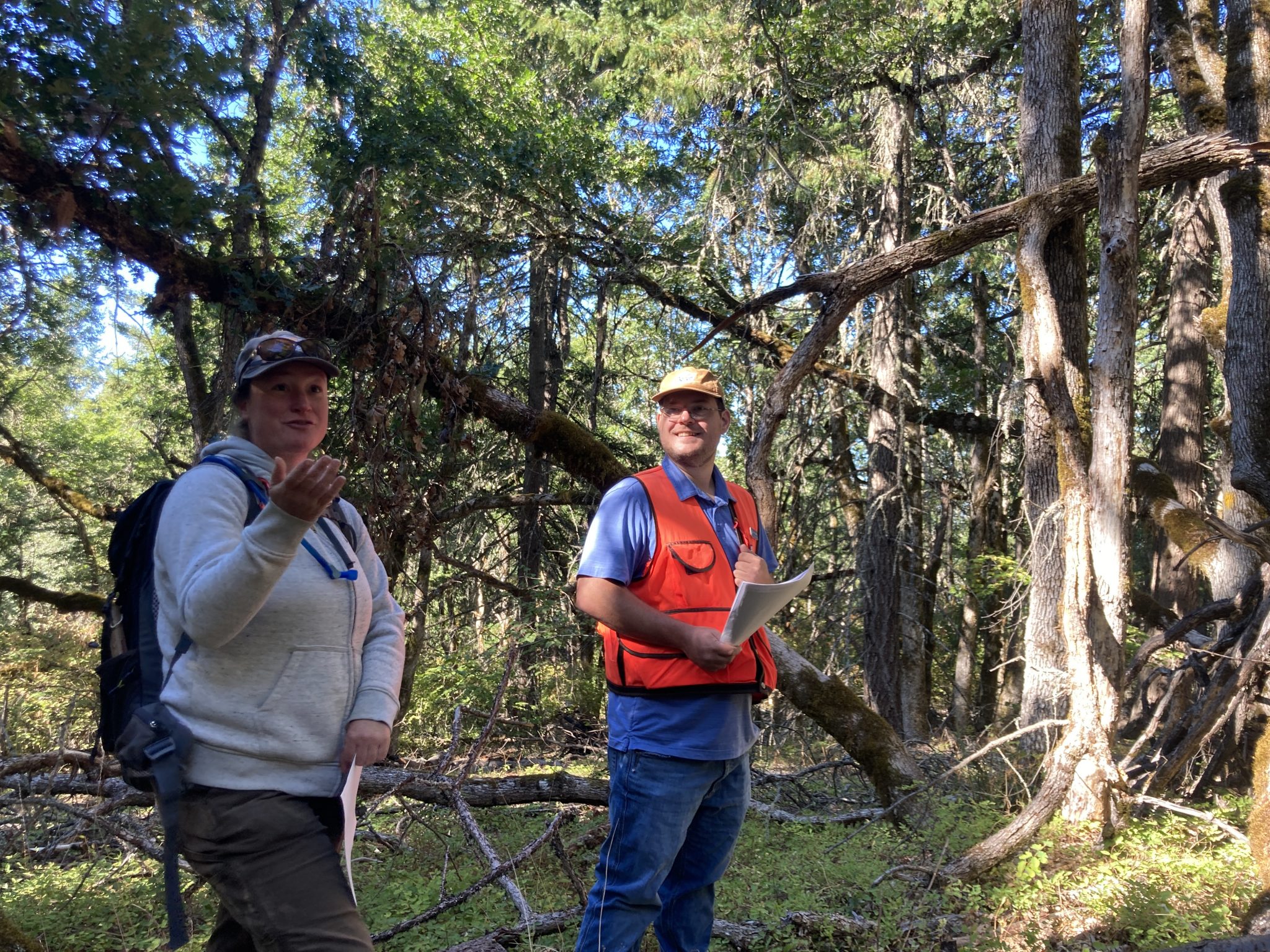
Many of us know and love our local Weldon Wagon Trail in the White Salmon Oak NRCA. The trail winds through a beautiful mixed oak and conifer woodland with colorful wildflower blooms and stunning views. To protect and care for this special place, Washington Dept. of Natural Resources (WA DNR) initiated a restoration project in June 2022. Their goal was to reduce conifer density around the oaks and release overtopped oaks from conifer encroachment.
Fire suppression efforts to protect infrastructure and timber investments began over a century ago in the East Cascades, leading to higher tree and shrub densities, accumulation of fuels, and proliferation of fire-sensitive vegetation. In the absence of natural fire and cultural burning, tree composition in wetter areas shifted toward fast growing Douglas-fir and other conifers. Eventually, these conifers can grow tall enough to shade out Oregon white oaks and even cause mortality. Without management, the oaks would have continued to be shaded out and the potential for catastrophic fire conditions would increase. The project deployed conifer thinning, strategic limbing, and snag creation (which contributes habitat value) to release the oaks and improve fire resilience.
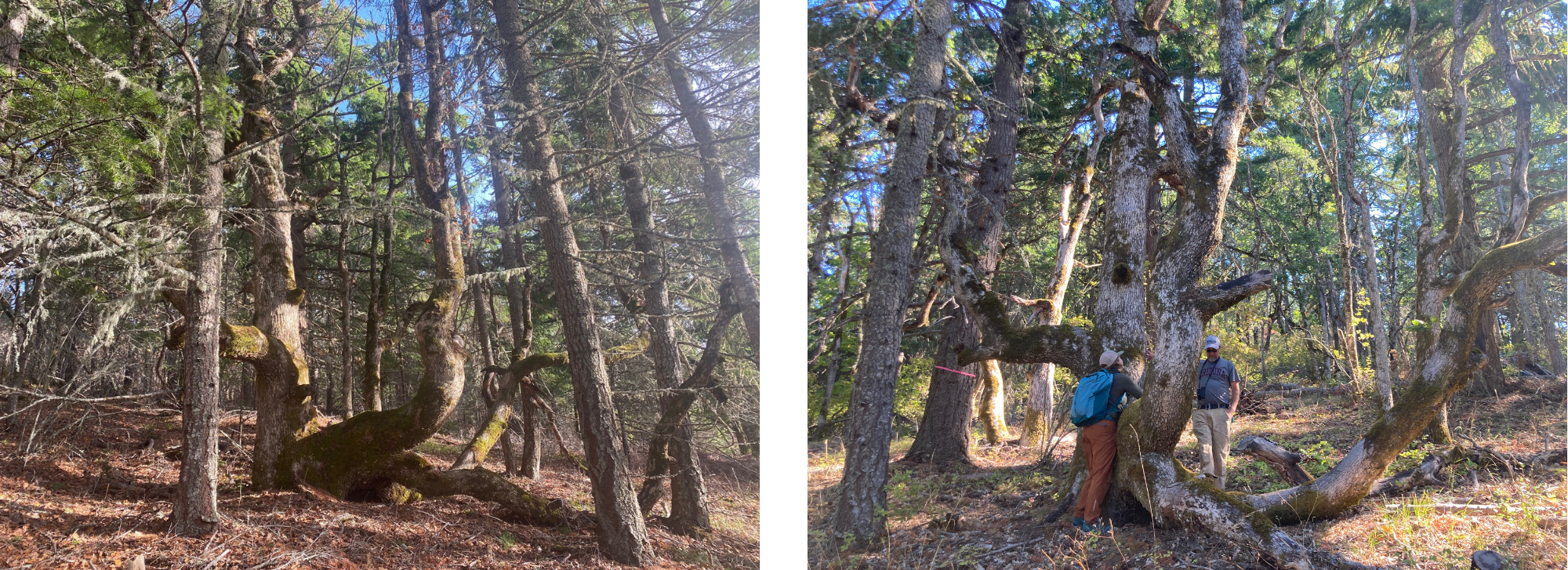
These before (left) and after (right) images show the balance that was achieved through the project design, which retained some larger mature conifers for habitat while simultaneously releasing oak from the competitive pressure of overtopping conifers.
This project saw the establishment of some of the very first ECOP monitoring plots, installed to better understand the effects of these treatments. WA DNR staff used the ECOP Disturbance Monitoring Protocol to document the effects of restoration on overstory community composition. Seven monitoring plots were installed across the project area with assistance by the East Cascades Oak Partnership staff. Pre-treatment monitoring was conducted in April 2022 and post-treatment monitoring was completed in July 2024.
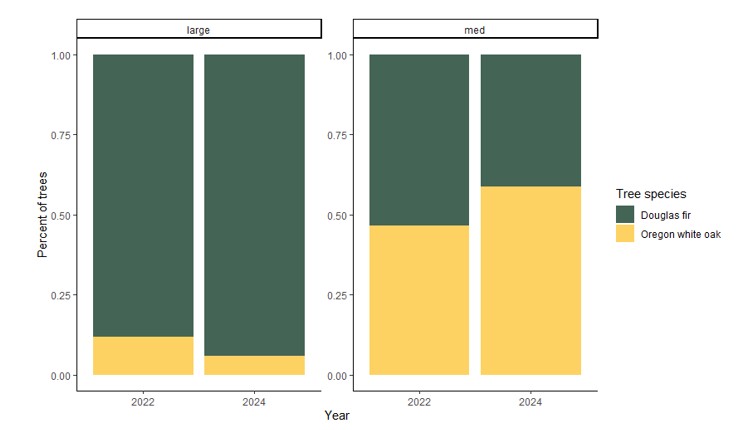
There were two tree species present within the monitoring plots—Oregon white oak and Douglas-fir. The biggest treatment effect was a significant reduction in medium sized trees (5-24” DBH). Medium trees averaged 11 trees per plot before treatment and 7 after treatment. We observed a shift towards slightly more Oregon white oak trees than Douglas-fir after treatment. There was also a shift towards more oak trees with open grown and dominant crown positions after treatment, indicating a positive shift in overstory composition and structure!
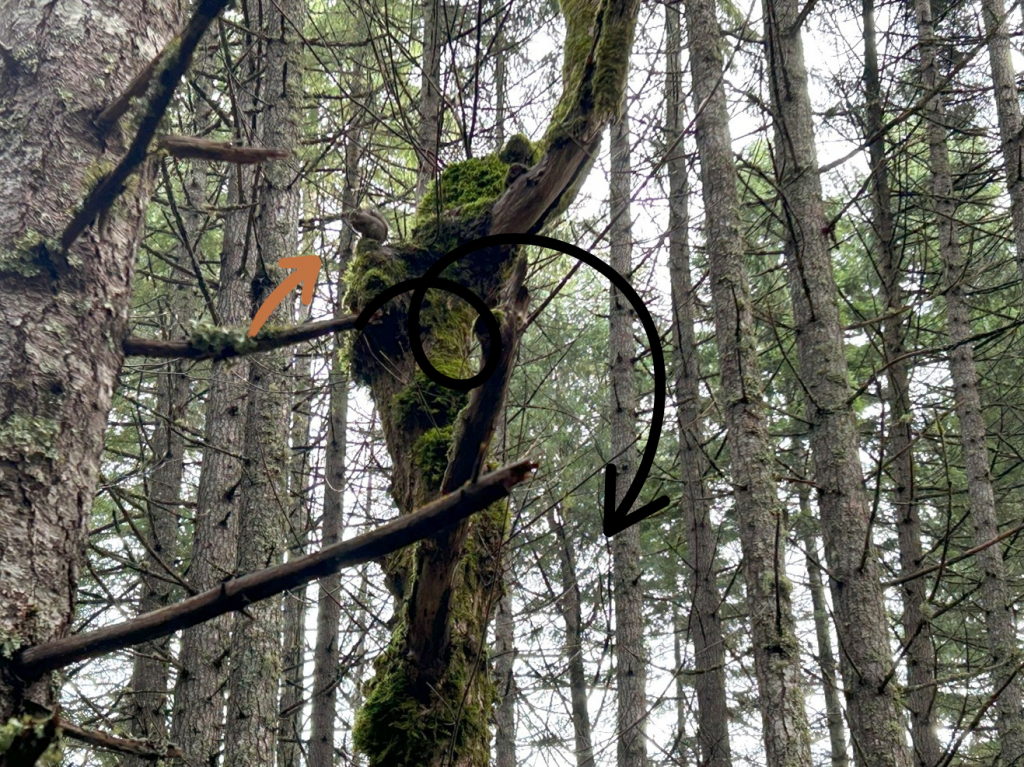
WA DNR staff shared, “Our Natural Areas staff learned a lot from implementing the ECOP Disturbance Monitoring Protocol at White Salmon Oak NRCA. It was exciting to contribute to early data collection and use those experiences to provide the ECOP team with feedback and edits for the protocol. We will continue to monitor our original plots to capture long-term impacts from the 2022 restoration effort and we are looking forward to establishing monitoring plots in the southern portion of White Salmon Oak, where additional restoration work is planned. We are grateful for our partners who support our efforts to maintain and preserve our unique oak ecosystems and the valuable habitat they provide. Check out that cute squirrel!"
Tree density and composition
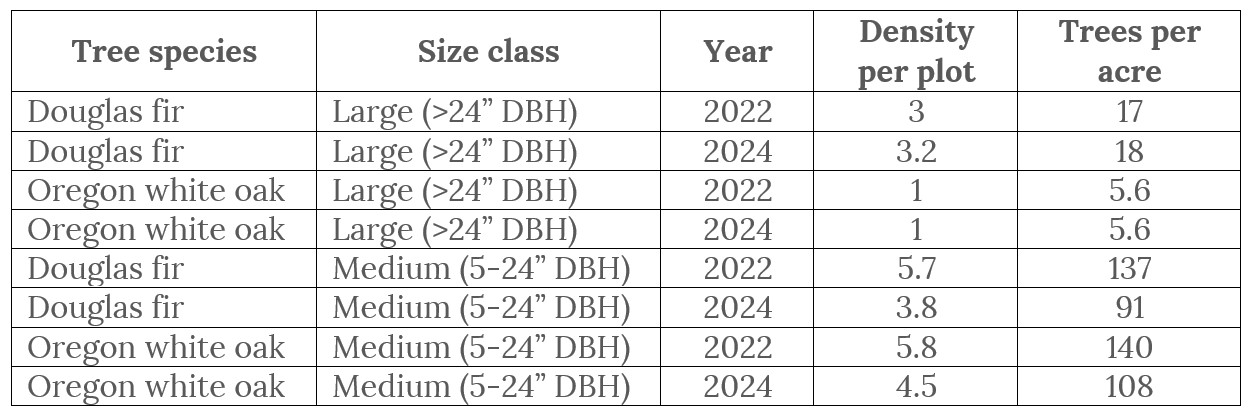
Before treatment in 2022, total tree density ranged from 7-19 trees per plot with an average of 13. After treatment in 2024, total tree density ranged from 3-12 trees per plot and averaged 9. There were no statistically significant differences between total tree density from 2022 to 2024 (p=0.07).
However, when splitting trees into medium (5-24” DBH) and large (>24” DBH) trees, there was a statistically significant difference in medium sized tree density from 2022 to 2024. Medium trees averaged 11 trees per plot before treatment and 7 after treatment. There was no difference in large tree density. Primarily Douglas-fir trees decreased in density. Medium DBH Douglas-fir trees averaged 137 trees per acre in 2022 and was 91 in 2024.
Tree species composition primarily shifted for medium DBH trees (5-24” DBH). After treatment, there were more Oregon white oak trees than Douglas-fir (Figure 2)
Lessons Learned
Since these were some of the very first ECOP monitoring plots installed, we have learned a lot about our monitoring methods! Over the years, we have added more fuels transects to better assess fine and coarse woody debris and fuel bed depth. We also learned from this project that May-July is typically the best time to complete the ECOP Disturbance Monitoring Protocol. Depending on the site, snow is melted, oaks are leafed out, and the plant understory is more easily identifiable during this time frame. We are always learning, and grateful to be doing so alongside our ECOP partners!